
Programmes
Developing talent for the UK's life sciences industry through a lifelong learning journey.
CognateHelix
A specialist life sciences enrichment programme for ambitious Year 12 students.
Equipping Tomorrow's Life Scientists for the Real World
Modern life sciences increasingly bring laboratory science and AI together. CognateHelix helps young people develop the scientific understanding, judgement and AI capability to learn and work confidently where the two meet.
The programme goes beyond teaching students how to use AI tools. It helps them evaluate evidence and make sound judgements when working with AI, knowing when to trust it, when to question it and when human judgement matters most.
These capabilities provide a strong foundation for university, apprenticeships and future careers across the life sciences.
Modern life sciences increasingly bring experimental science, data analysis and AI together. CognateHelix uses the term 'Bilingual Scientist' as shorthand for the ability to understand and reason across experimental and computational approaches, even where a student may later specialise more deeply in one.
It is designed to complement, not replace, students' existing studies.
At a Glance
Who CognateHelix Is For
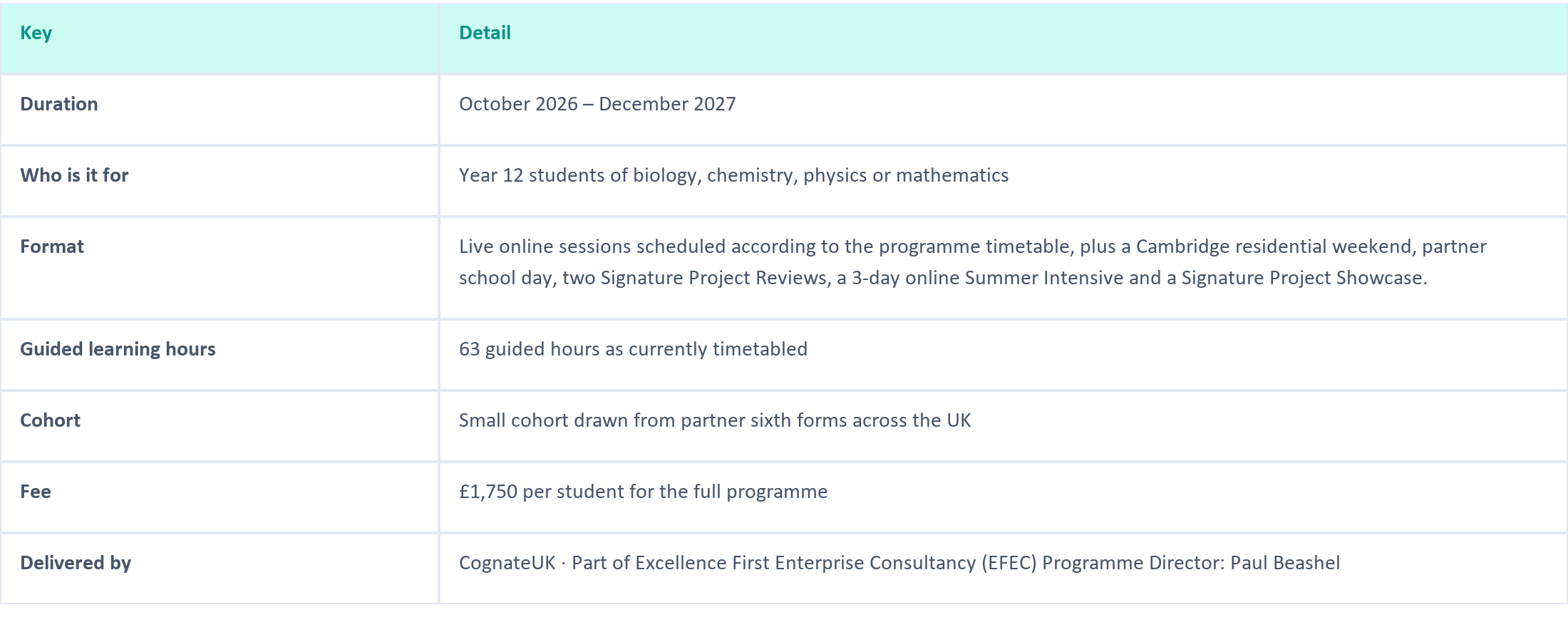
CognateHelix is designed for Year 12 students who:
- •are studying biology, chemistry, physics or mathematics at A-level
- •have a genuine interest in how life sciences is evolving
- •are curious about how AI and data science are reshaping research, medicine, and innovation
- •engage seriously with complex ideas and want to develop how they think and articulate
The programme is not biology-only. Its three Grand Challenge themes have entry points for students across the sciences and mathematics.
What This Looks Like in Practice
For example, a student might explore a question such as:
How should artificial intelligence be used in clinical decision-making?
Through guided discussion and structured analysis, the student:
- •examines real-world scenarios where AI and human judgement differ
- •evaluates the evidence, develops their own position on trust, responsibility, and risk
- •presents and defends their reasoning as part of a portfolio of work
This kind of work makes visible how a student thinks, not just what they know.
Five Integrated Modules
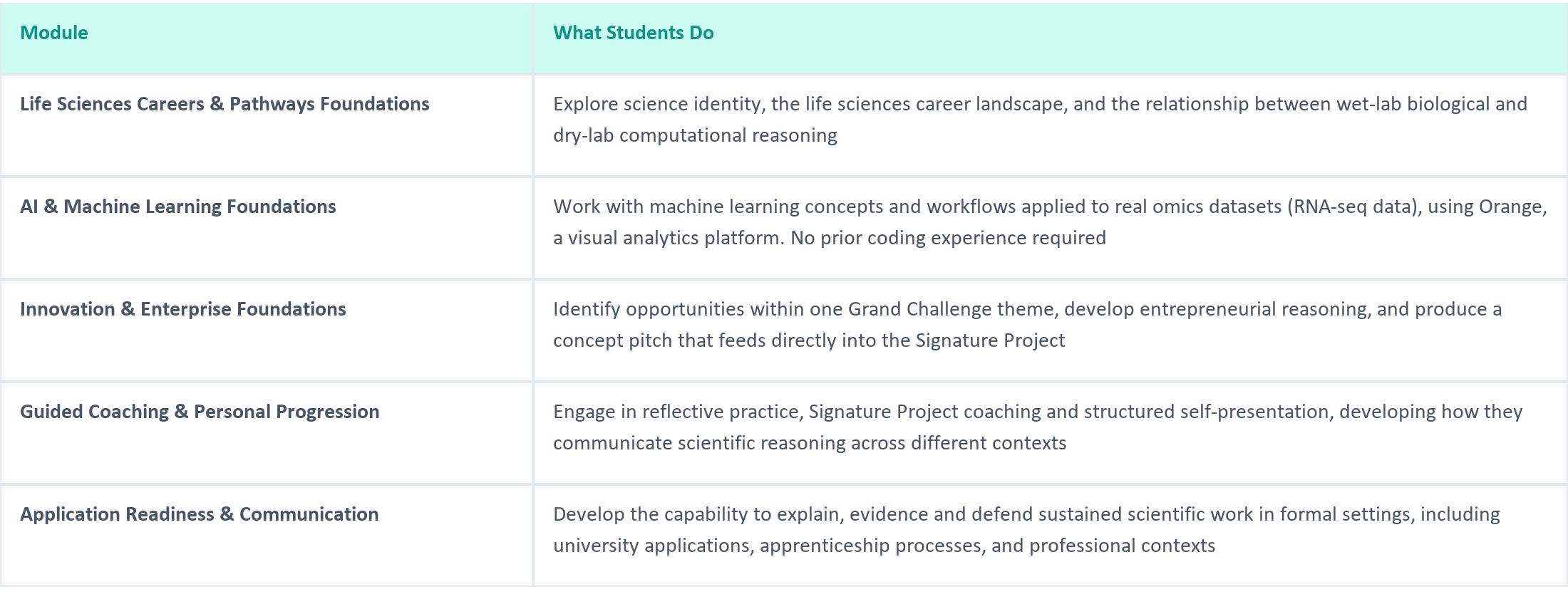
The modules are sequenced deliberately, each building on the last, and all contributing to the Signature Project Portfolio.
The Signature Project Portfolio
Every module except Application Readiness & Communication contributes content to the Signature Project, in which students apply machine learning techniques to a real biological dataset within one of three Grand Challenge themes: Healthy Ageing, Pandemic Prevention, or Net Zero.
The analytical work is done in Orange, no coding required.
Application Readiness & Communication then develops the capability to explain, evidence and defend the completed project in whichever formal setting each student is heading towards, whether that is a university application, an apprenticeship process, or a professional context.
The Portfolio documents intellectual development over the course of the programme: it makes visible what grades alone cannot show.
Where Students Go from Here
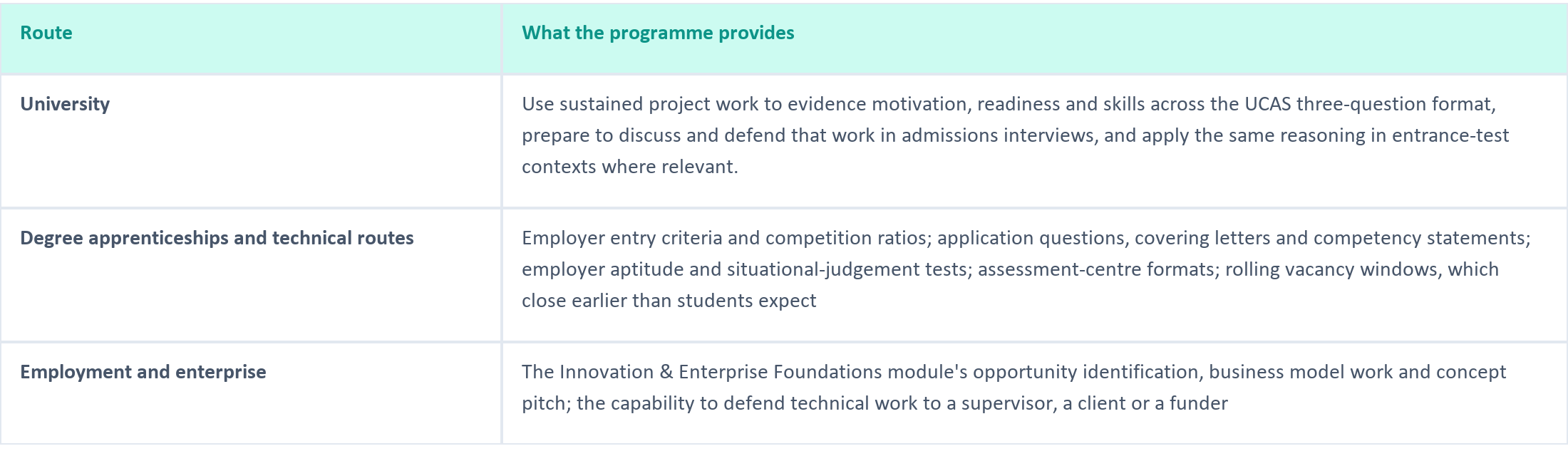
University is likely to be a common progression route for CognateHelix students, and the programme serves it fully. It is not the only one, and the design does not treat it as the default.
Application Readiness & Communication is built as capability development rather than admissions coaching. The capability (explaining, evidencing and defending sustained work under questioning) is the same whether a student is writing a personal statement, sitting a university interview, answering competency questions for a degree apprenticeship, or presenting technical work to colleagues. The module teaches the capability once and practises it in the context each student will actually meet.
CognateHelix and the Extended Project Qualification
The two work best in combination rather than as alternatives, and students already taking an EPQ are among those who gain most.
An EPQ supplies an assessment structure (a mark scheme, a production log and a single submission) but no domain content, and school supervisors are rarely specialists in the chosen topic. CognateHelix supplies what a solo EPQ struggles to provide: subject depth in modern life sciences, a structured way of arriving at a distinctive research question, access to faculty beyond one supervisor, and computational capability a school cannot usually resource.
Depending on the individual school and EPQ arrangements, it may be possible for the Signature Project and the EPQ to draw on the same underlying body of work, written up in two complementary ways. We are happy to work with students and their schools to explore alignment where appropriate.
The EPQ's heaviest months fall in the Year 12 summer and early Year 13, when the CognateHelix timeline is lightest.
For students considering medicine or dentistry, the value of an EPQ may lie less in admissions advantage and more in developing a distinctive piece of work they can explain and defend with confidence.
A fuller treatment is available in the CognateHelix and the EPQ briefing note (V2.1), on request.
Key Events
What Makes CognateHelix Different
Most enrichment provision treats AI as a separate subject or focuses narrowly on technical skills. CognateHelix is built differently: AI and computational reasoning are embedded within authentic scientific problems from the start, so students develop judgement alongside capability. Five features set it apart:
- •Students learn to reason across experimental science, data analysis and AI-directed computational approaches, developing the ability to connect different ways of approaching a life sciences problem.
- •One sustained project over the full programme. Students apply machine learning to real published biological datasets and defend their reasoning to peers and the programme team. Not a series of disconnected tasks.
- •Three Grand Challenge themes (Healthy Ageing, Pandemic Prevention, Net Zero) with entry points for biology, chemistry, physics and mathematics students. The programme is not biology-only.
- •Guided Coaching & Personal Progression coaches students through reflective practice and structured self-presentation, developing how they communicate their scientific reasoning, not just the reasoning itself.
- •Application Readiness & Communication develops the capability to explain, evidence and defend sustained work across formal settings, from university applications to apprenticeship processes and professional contexts. The programme's intellectual content carries forward into how students present themselves, wherever they are heading.
What Students Learn to Do
By the end of CognateHelix, students:
- •Move between experimental and computational approaches to scientific problems
- •Evaluate evidence and make sound judgements when working with AI and data-driven analytical tools, reasoning from outputs without needing to write code
- •Present and defend a sustained piece of work in a structured setting, including under questioning from the programme team and peers
- •Document intellectual development over time through a Signature Project Portfolio, making visible what grades alone cannot show
- •Articulate genuine cross-disciplinary engagement clearly in formal settings
The capabilities CognateHelix develops are not tied to a single destination. The ability to evaluate evidence, reason clearly, communicate under questioning and work with uncertainty provides a strong foundation for university, apprenticeships and future careers across the life sciences. A student does not need to have settled on a destination to benefit.
CognateHelix awards no qualification and no grades; nothing is accredited or credit-bearing. Students who meet the completion threshold receive a Completion Statement. That is deliberate: the portfolio is evidence of how a student thinks, which is what whoever is selecting them is trying to establish. No programme can promise a university place or a job offer, and we make no such claim.
The CognateUK Learning Platform
CognateHelix is supported by a secure digital platform designed for discussion-based learning. The platform includes ProfBot, an AI-supported learning assistant that helps students continue exploring ideas between sessions, organise their thinking, and reflect on their learning. ProfBot is designed to support, not replace, teaching.
Programme Fee
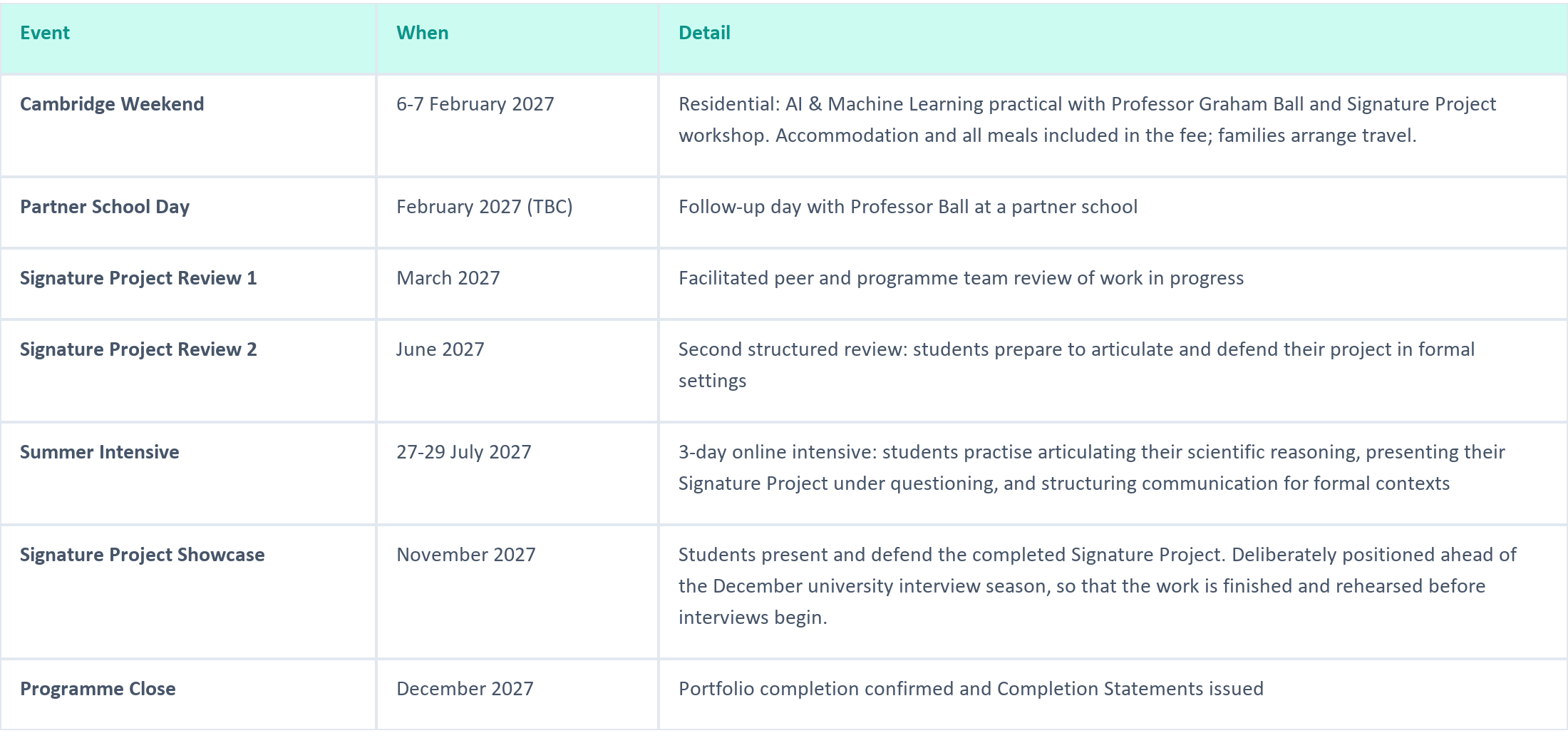
The full programme fee is £1,750 per student. This covers all online sessions, individual and small-group coaching, the Cambridge residential weekend (accommodation and all meals), partner school day, both Signature Project Reviews, the 3-day online Summer Intensive, and the Signature Project Showcase. The fee does not cover travel costs to and from Cambridge or to and from the partner school.
For school partnership enquiries, please contact: Paul Beashel, Programme Director, paul.beashel@excellence-first.com
About CognateUK
CognateUK is an initiative of Excellence First Enterprise Consultancy (EFEC), established in 2006. It is dedicated to capability formation, helping people prepare for the changing realities of work and professional life in an AI-enabled world.
The initial focus is life sciences. CognateHelix is the first expression of that vision: a structured programme developing the scientific understanding, judgement and AI capability the modern life sciences workforce demands.
Enquiries
Interested in CognateHelix? Send us an enquiry and we’ll get back to you.